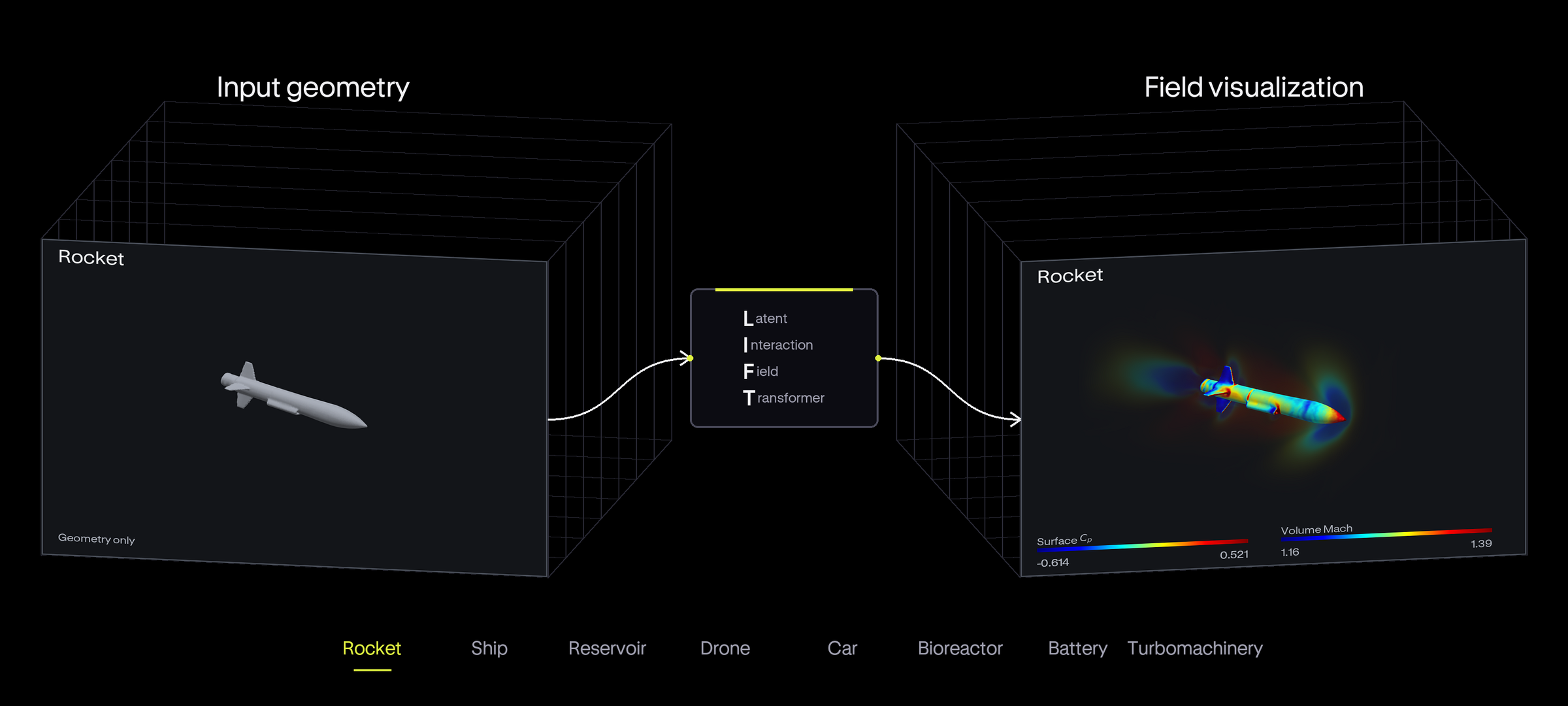
Computational fluid dynamics (CFD) describes one connected physical system. Air does not stop at the vehicle surface: pressure and friction shape the surrounding flow, while the wake and near-body flow determine the forces acting on the vehicle. Because the physics depends on the global dynamic, an AI model should preserve that relationship instead of turning one simulation into a collection of disconnected predictions.
LIFT, our Latent Interaction Field Transformer, in the context of automotive simulation, predicts surface and volume fields globally. Its surface and volume modalities retain specialized spatial representations while exchanging information in the latent space before producing their fields. The result is a shared view of the fields. The coupling of the fields is closer to how engineers understand a simulation: as one physical system.
That coupling between modalities is designed for speed as well as coherence. One high-fidelity CFD simulation requires thousands of CPU core hours. In seconds, LIFT moves the learned prediction step into interactive time, giving teams room to explore more candidates before committing the strongest options to high-fidelity simulation.
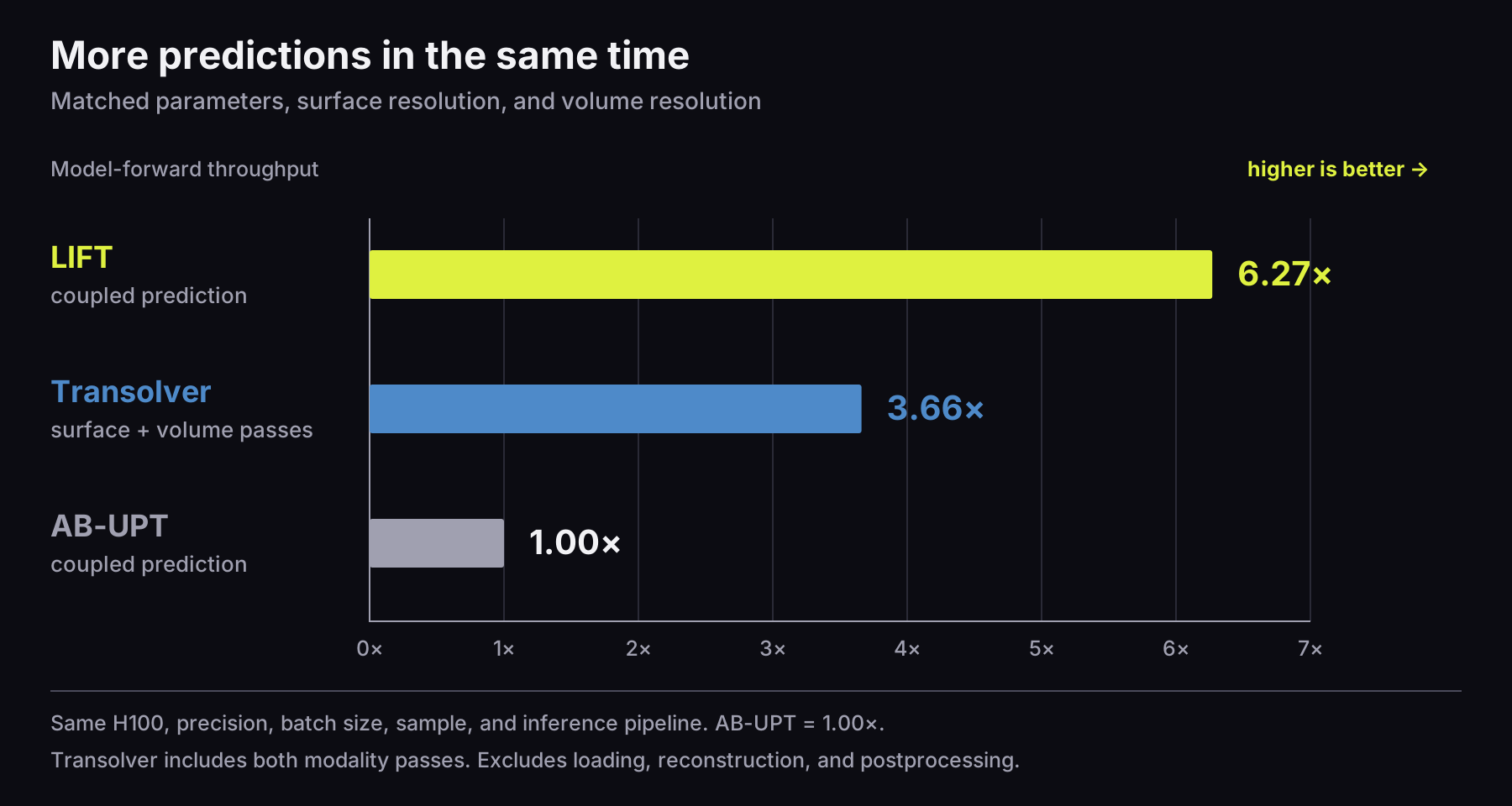
Our unique architecture makes that prediction efficient relative to competing model approaches. At the same surface and volume resolution, under a matched-parameter comparison, LIFT delivers up to 6× the model throughput of competing architectures. The result is a faster iteration turnaround from a geometry change to a useful view of the coupled flow.
On the high-fidelity DrivAerML automotive benchmark, LIFT delivers the strongest volume-pressure result in the current comparison. It produces both spatial domains with one model, while some leading comparison architectures require separate models for the surface and volume.
1 Connecting surface and volume physics
Although the surface and volume belong to the same flow, they are determined by different forms of the governing physics. At the vehicle boundary, the equations describe how the fluid interacts with a solid wall and translate near-wall behavior into pressure and shear. In the surrounding volume, they describe how mass and momentum move through the flow to produce pressure and velocity. This is why each modality benefits from its own spatial representation even while the two must remain coupled.
LIFT treats the surface and volume as distinct modalities, then allows information to move between them through latent interaction. For example, surface context can inform the wake and near-wall flow, while volume context can inform pressure and shear on the body. Each modality benefits from the other without losing the specialization needed for its own field.
This design differs from running two independent models. A geometry change is represented once, and its effects can propagate across the whole predicted flow. For engineering teams, that creates a more coherent foundation for design exploration, downstream force calculations, and future multi-physics extensions.
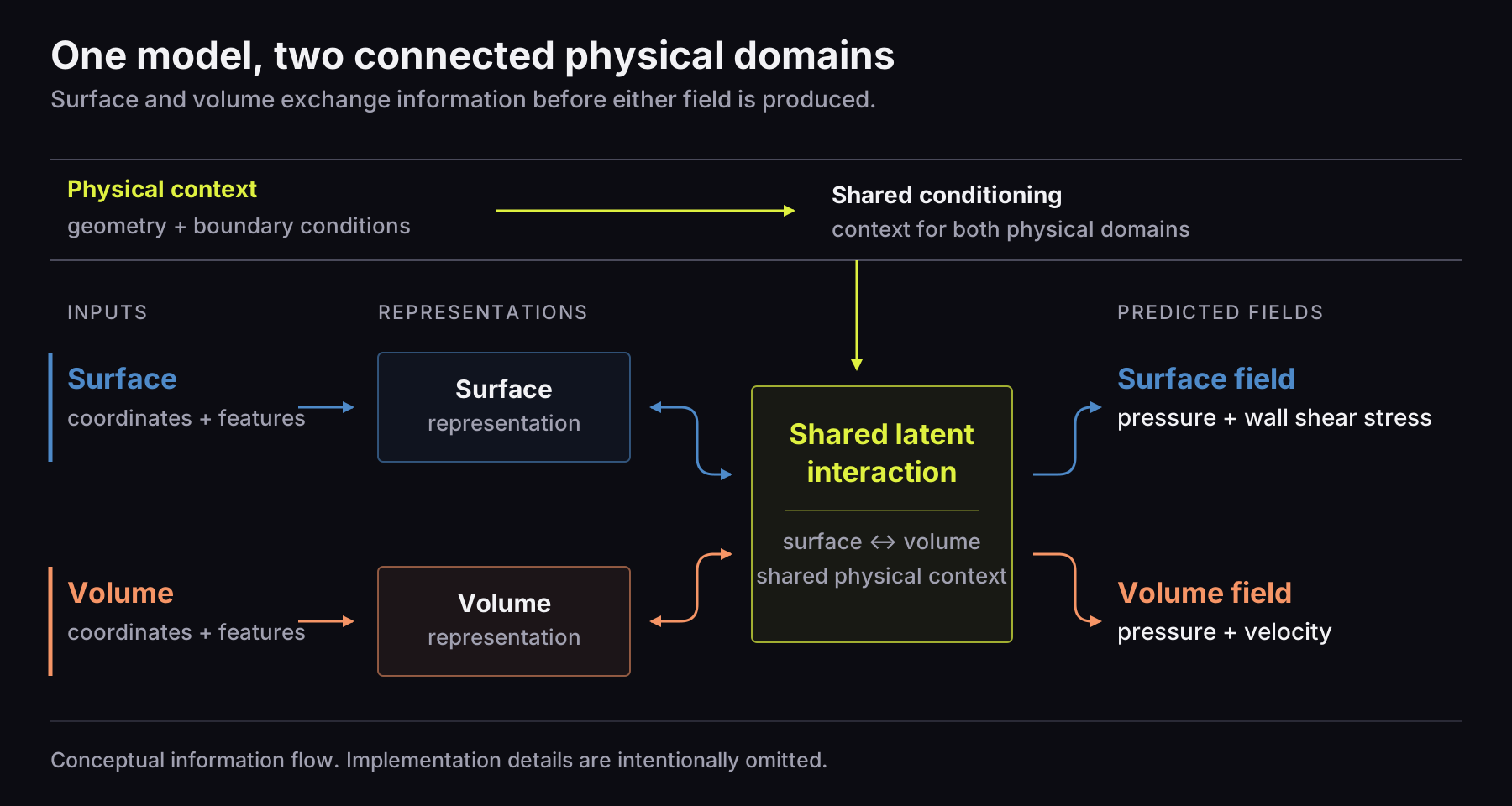
Industrial CFD meshes can contain tens or hundreds of millions of cells. LIFT prediction is mesh free, and carries its shared physical context across the full field by evaluating the remaining surface and volume locations in manageable chunks of arbitrary query locations, then restoring predictions to the original mesh order. Chunking changes how the work is scheduled, not what the model returns, so every location of interest still receives a prediction, regardless of resolution.
2 Accelerating the design loop
High-fidelity CFD remains essential for final verification, but its computational cost makes it difficult to place inside every design iteration. A single industrial-scale case can cost hours of HPC compute. That naturally limits how many ideas a team can test and how quickly it can respond to a promising direction.
LIFT changes the role of prediction earlier in the process. Engineers can screen candidate geometries rapidly, remove weaker options sooner, and focus their simulation budget on designs with the strongest potential. Because surface and volume are predicted together, speed does not require giving up the connected view of the airflow.
To isolate architectural efficiency, we evaluated LIFT, AB-UPT, and Transolver with matched parameters, the same surface and volume resolution, and one shared inference pipeline. LIFT delivered 1.72× the throughput of Transolver's two-model surface-plus-volume path and 6.27× the throughput of AB-UPT. Because Transolver predicts the two modalities separately, its comparison includes both required forward passes.
3 Comparing field-level accuracy
DrivAerML provides a standard test of full-vehicle aerodynamic prediction at industrial mesh scale. We evaluate LIFT on surface and volume fields using mean global relative L2 error. Each metric is computed over its corresponding physical field so that the comparison reflects field quality in each modality rather than a single blended score.
LIFT produces all four fields with one combined model. The Transolver family evaluates surface and volume with separately trained models. Transolver’s numbers are therefore a result of two forward passes instead of one.
| Model | Surface pressure | WSS | Volume pressure | Velocity |
|---|---|---|---|---|
| LIFT | 3.97% | 6.32% | 3.66% | 5.20% |
| AB-UPT | 3.82% | 7.29% | 6.08% | 5.93% |
| Transolver | 4.81% | 8.95% | 7.74% | 6.78% |
The comparison remains directional rather than a universal leaderboard because the published models use different training code, preprocessing, and evaluation details. A reproduction of the officially reported scores of competing models is not attempted. Even with that limitation, the benchmark shows that LIFT is competitive and, in some areas, even better at industrial resolution within an efficient parameter budget.
4 Scaling naturally to multi-physics
A unified model does more than simplify training and deployment processes. By keeping related predictions connected, LIFT creates a natural foundation for adding new kinds of physics without introducing another isolated model for every output.
The current benchmark focuses on CFD, but the design principle is broader. Real engineered systems rarely stop at one kind of physics. Aerodynamic loads interact with structures, heat changes material behavior, and acoustic effects emerge from the same geometry and flow. Treating each output as an isolated prediction fragments both the model and the engineering workflow.
LIFT is organized around interacting modalities rather than a fixed pair of outputs. Each modality can retain the representation suited to its governing relationships while sharing information with the rest of the system. The same pattern shown here for surface and volume is designed to extend naturally to thermal, structural, and other physical properties.
This gives teams a path toward one expanding foundation for multi-physics design. New capabilities can join a connected prediction system instead of becoming another independent model to train, deploy, and reconcile.
5 LIFT in practice
The value of physics AI is not only a lower benchmark error. It is the ability to turn a learned view of a physical system into better engineering decisions. Beyond automotive CFD, our application work spans aerodynamic design, ship hydrodynamics, bioreactor modeling, and reservoir simulation.
In drone aerodynamics, an adapted LIFT model achieved 4% mean percent error in drag and lift across a diverse set of more than 100 CFD cases with varying boundary conditions. With each sample running under 3 seconds, a separate model-guided search evaluated 5,800 candidate designs in 6 hours 18 minutes of aggregate GPU time, equivalent to 19 minutes of elapsed time with 20 GPUs in parallel and identified a design with 21% lower predicted drag at equal modeled lift. The improvement is model-predicted, not independently CFD-verified. This demonstrates the value of combining accurate, fast prediction with high-fidelity CFD for final verification.
In a separate rocket-aerodynamics evaluation, a model achieved average percentage errors of under 1% for the drag coefficient and under 2% for the lift coefficient on held-out CFD cases.
The applications extend beyond airflow. A ship-hydrodynamics model predicted pressure and wall-shear fields on unseen validation hulls. For cases with dynamic fluid-body interaction (DFBI), an additional prediction head targets sinkage and pitch. An early bioreactor pilot reported under 4% error for gas holdup and under 6% for oxygen transfer, measured through the volumetric mass-transfer coefficient, kLa. The bioreactor results remain preliminary; their percentage-error definition, evaluation split, and case count have not been established, so they are not directly comparable to the aerodynamic percentage errors or full-field relative L2 results.
Reservoir modeling brings the same idea to underground multiphase simulation. A LIFT model learns pressure and fluid-saturation fields on faulted, unstructured grids. In a full-field benchmark, mean absolute errors stayed below 1 bar for pressure and 0.01 in saturation fraction over a nine-year rollout, with reported training more than 3× faster than an in-house Fourier Neural Operator at comparable accuracy. A model-guided history match performed more than 7,000 forward evaluations in under an hour on a laptop. These results connect field prediction to geological calibration and forecasting when water may reach a producing well.
These applications reflect the engineering ambition behind LIFT: make physical prediction useful throughout the design process. The opportunity is to explore more possibilities, understand their consequences, and bring stronger candidates to high-fidelity simulation.
Appendix: Relative L2 error
Relative L2 error measures the size of a prediction error across an entire field, relative to the size of the reference CFD field. For one case and one field with a nonzero reference norm, it is
Here, is the reference value and is the prediction at evaluation point and component . Pressure is a scalar field, so . In our LIFT evaluation, velocity includes all three vector components; the reported wall shear stress (WSS) score instead compares the scalar magnitudes of the predicted and reference shear-stress vectors. Points are equally weighted, without surface-area or cell-volume weighting, and predictions and references are evaluated in the same physical units after denormalization.
References
- Ashton, N., et al. (2024). DrivAerML: High-Fidelity Computational Fluid Dynamics Dataset for Road-Car External Aerodynamics.
- Alkin, B., et al. (2025). AB-UPT: Scaling Neural CFD Surrogates for High-Fidelity Automotive Aerodynamics Simulations via Anchored-Branched Universal Physics Transformers.
- Wu, H., et al. (2024). Transolver: A Fast Transformer Solver for PDEs on General Geometries.
- Wen, S., et al. (2025). Geometry Aware Operator Transformer as an Efficient and Accurate Neural Surrogate for PDEs on Arbitrary Domains.