At high speeds in rough water, a planing vessel can go from controlled motion to violent heave, pitch, and hull re-entry in seconds. Predicting that behavior requires resolving strongly coupled vessel motion, hydrodynamic loading, and a rapidly evolving air-water interface.
In this study, we built and validated a high-fidelity transient seakeeping methodology, investigated where the vessel response becomes strongly nonlinear, and used the resulting physics to develop real-time prediction capability with UniversalAGI’s Latent Interaction Field Transformer (LIFT).
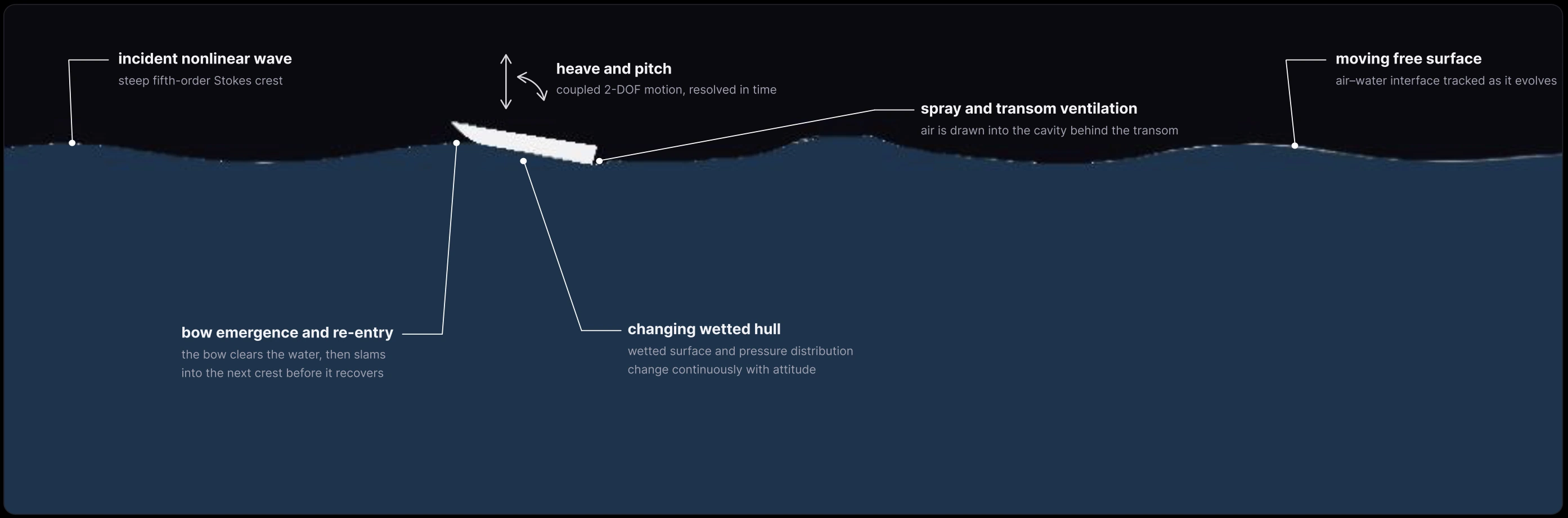
Modeling a high-speed planing vessel’s response to oncoming waves requires resolving a moving hull interacting with a moving air-water interface while both evolve together in time. As the vessel pitches upward, its wetted surface and pressure distribution change. Those loads drive the next heave and pitch motion, which changes how the hull meets the following wave. Spray forms and separates, the transom ventilates, sections of the hull can leave the water entirely, and the next wave encounter can drive an impulsive re-entry. At high speeds, this sequence can repeat every few seconds.
Capturing that behavior across an operating envelope traditionally requires a new high-fidelity transient seakeeping simulation for every combination of wave condition, speed, heading, and vessel state. Individual cases can run for days, and a sufficiently broad campaign can consume hundreds of thousands of CPU core-hours and tens of thousands of dollars over weeks or months before the resulting response space has been characterized.
The objective was to make this physics available on a fundamentally different timescale for a high-speed planing vessel.
We built and validated a high-fidelity seakeeping simulation pipeline, characterized the vessel response across a range of wave conditions, and used the results to develop real-time physics AI capability using UniversalAGI’s Latent Interaction Field Transformer (LIFT) model architecture.
The resulting analysis revealed a sharp nonlinear transition in the vessel dynamics. At the most demanding condition we evaluated, increasing incoming wave amplitude by 50% produced 79% greater peak-to-peak resistance, 128% greater heave response, and 365% greater pitch response. The vessel also developed a period-doubled response with substantially harder hull re-entry.
These transitions matter directly to autonomous operation. A maneuver that appears safe based on perception and navigation can expose the vessel to a dramatically different physical response as the sea state, speed, or heading changes.
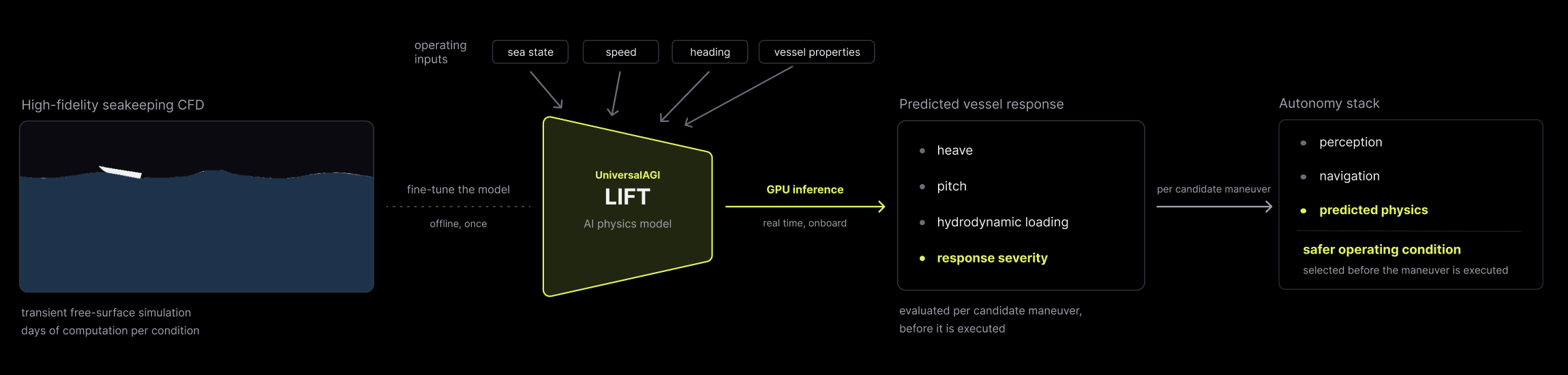
By making vessel-response physics available at GPU inference speeds, UniversalAGI creates a path to incorporate predicted heave, pitch, loading, and dynamic response directly into real-time navigation and control. This changes the role of high-fidelity seakeeping physics from an offline engineering analysis to information that can be evaluated on the timescale of an operating decision.
Highlights
- High-speed planing-vessel response was studied using high-fidelity transient seakeeping CFD across a range of wave conditions.
- The physics was established through a validation hierarchy spanning published planing-hull experiments, Savitsky theory, nonlinear Zarnick strip theory, dedicated wave-propagation studies, and high-fidelity transient seakeeping CFD simulations.
- At the most demanding evaluated condition, a 50% increase in wave amplitude produced 79% greater resistance, 128% greater heave response, and 365% greater pitch response.
- The vessel transitioned into a strongly nonlinear, period-doubled response, showing why response behavior cannot always be safely extrapolated from nearby operating conditions.
- UniversalAGI’s LIFT physics AI model makes these learned vessel dynamics available at GPU inference speeds rather than requiring a new transient CFD simulation for every evaluation.
1 Why high-speed seakeeping is so difficult
The vessel studied in this program operates firmly in the planing regime, and its operating condition can be characterized by the high Froude number,
where is vessel speed, is hull length, and is gravitational acceleration.
In this regime, the hull relies primarily on dynamic lift rather than buoyancy. The wetted surface changes continuously as the hull heaves and pitches, which changes the pressure distribution and therefore the forces driving the next vessel motion.
The incoming waves introduce another important timescale. For a deep-water wave,
where is the wave angular frequency and is the wave number. For a vessel advancing into head seas, the encounter frequency becomes
where is the angular frequency at which the advancing vessel encounters the waves.
At the most demanding frequency in our study, , the vessel encounters successive waves roughly every 1.5 seconds. Within that short interval, the numerical model has to resolve the evolving free surface, changing wetted hull, dynamic heave and pitch, spray, ventilation, pressure loading, and repeated hull entry and exit from the water.
A single high-fidelity seakeeping condition can require days of transient computation. Characterizing an operating envelope across wave conditions, speed, heading, loading, and control settings quickly grows into weeks of engineering work, hundreds of thousands of CPU core-hours, and tens of thousands of dollars. That level of computation may be appropriate for establishing trusted reference physics, but far too slow for an autonomy system making decisions at sea.
2 Establishing physics we could trust
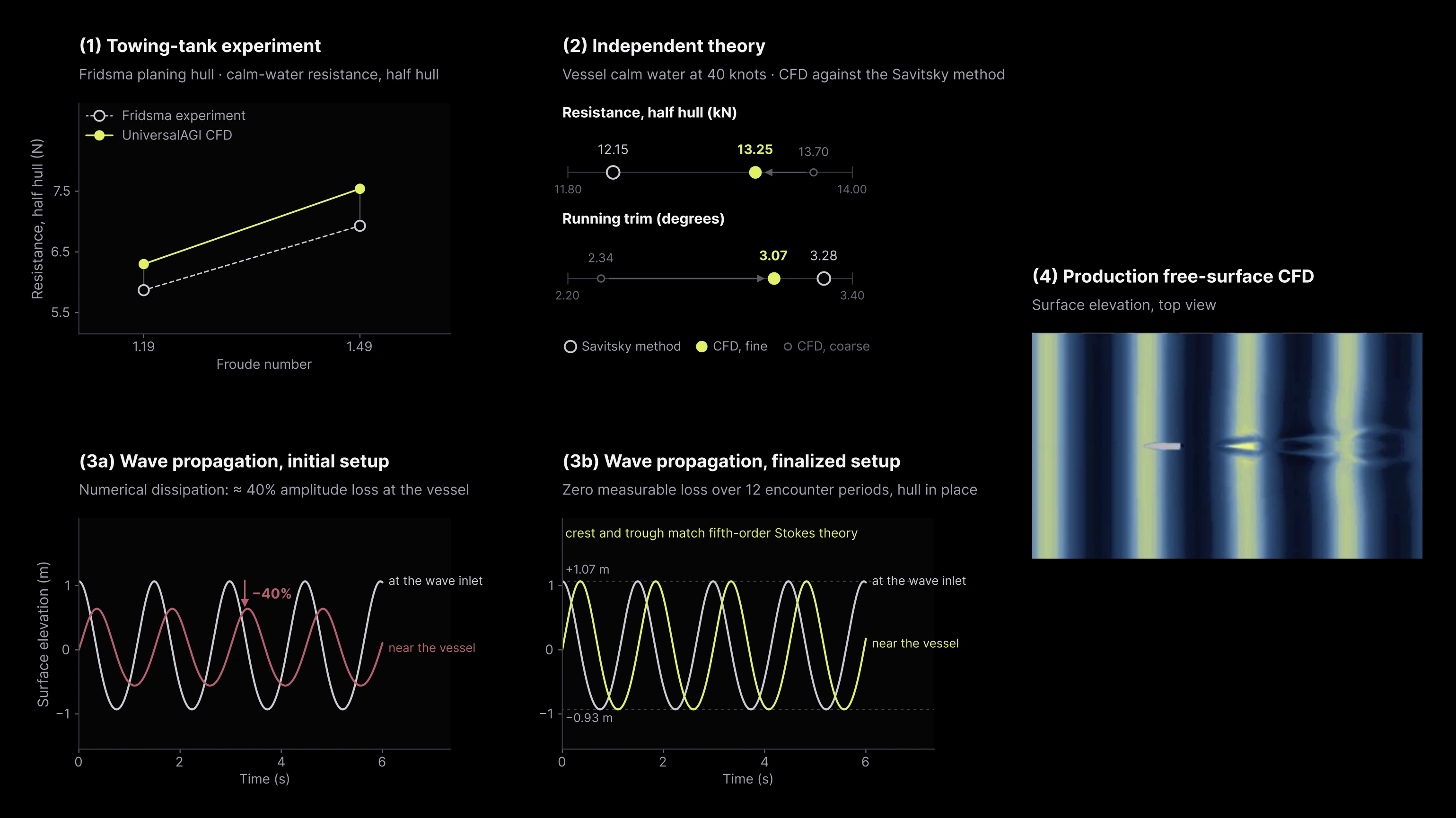
Before using the simulation results for downstream modeling, we validated the underlying methodology against several independent sources. We first compared the CFD against published Fridsma towing-tank experiments [1], a widely used reference for high-speed planing-hull hydrodynamics, and verified that the predicted resistance closely reproduced the experimental measurements across the validation speeds. We also implemented Savitsky’s planing-hull method [2] as an independent analytical check on running trim, resistance, wetted length, and hydrodynamic lift. We observed that for the planing vessel operating at high speeds, the refined calm-water CFD was well aligned with the independent Savitsky resistance prediction.
The waves themselves required equally careful validation. An early numerical configuration produced a regular wave that looked physically reasonable, but numerical dissipation reduced its amplitude by approximately 40% before it reached the vessel. Any vessel response computed using that wave would therefore have been based on the wrong forcing. We ran a dedicated campaign of wave-propagation experiments to isolate and eliminate the damping in the solver numerics [8], [9]. In the finalized wave-only configuration, the CFD reproduced the expected fifth-order Stokes extrema of approximately +1.07 m at the crest and −0.93 m at the trough. We then returned the hull to the domain and confirmed that the incident wave still reached the bow with effectively zero measurable amplitude loss.
3 Finding where the vessel response becomes strongly nonlinear
We also implemented a nonlinear time-domain model based on Zarnick strip theory [3] to understand the vessel response before running the CFD campaign. In the Zarnick formulation, the vertical hydrodynamic force on a transverse hull section can be written as
where is the sectional vertical force, is the total derivative following the moving hull section, is sectional added mass, is relative velocity normal to the hull baseline, is the cross-flow drag coefficient, is water density, is sectional beam, is submerged sectional area, and is the buoyancy-force factor.
Integrating these forces along the hull gives the coupled heave and pitch response of the vessel. We validated our implementation against published Zarnick calculations and Fridsma experimental data, giving us an independent model for identifying the frequencies where higher-order behavior should become important.
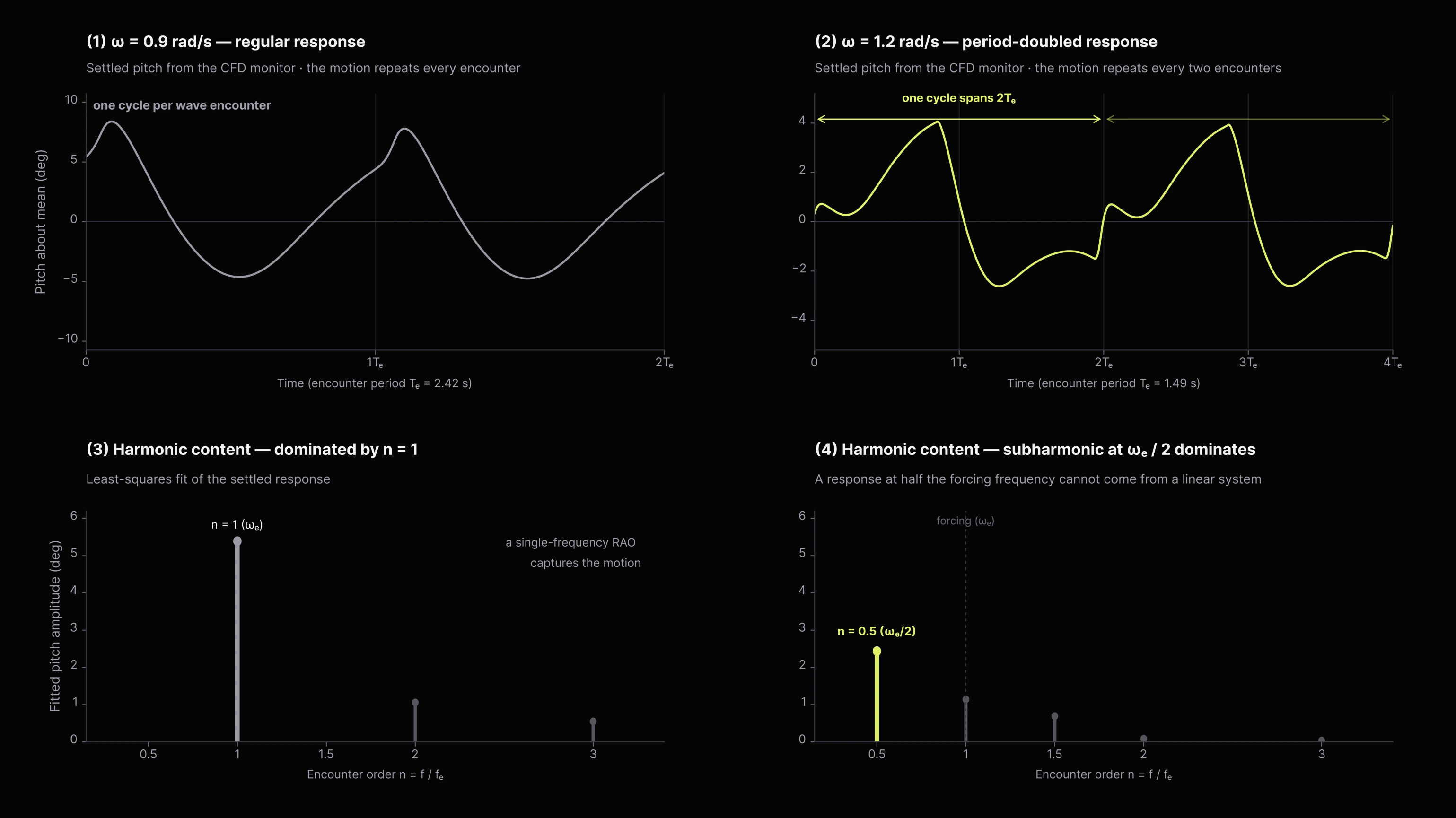
The lower-frequency conditions behaved relatively regularly. Most of the vessel motion remained concentrated around the primary encounter frequency, so conventional response amplitude operators, or RAOs, captured the dominant behavior. But the higher-frequency cases were substantially different.
For a regular incoming wave, the free-surface elevation can be represented as
where is the surface elevation, is the incident-wave amplitude, and is time. We reduced the settled vessel response in the frequency domain using a harmonic decomposition [4]–[7]:
where is the mean response, and and are the fitted coefficients at encounter order . Integer encounter orders were evaluated for every case; for the longer recurring response at 1.2 rad/s, the half-order components were included explicitly.
At low frequencies, heave and pitch were governed primarily by the encounter component. But at 1.2 rad/s, a strong half-order response appeared at , corresponding to the frequency .
The vessel was now repeating its motion over approximately two wave encounters instead of one. This period-doubled response is a clear signature of strongly nonlinear dynamics. It also marks an important limit of conventional linear-response approaches: a single amplitude-independent RAO no longer captures the actual character of the vessel motion.
(1) ω = 0.9 rad/s
(2) ω = 1.2 rad/s
4 A 50% increase in wave amplitude produced a 365% increase in pitch
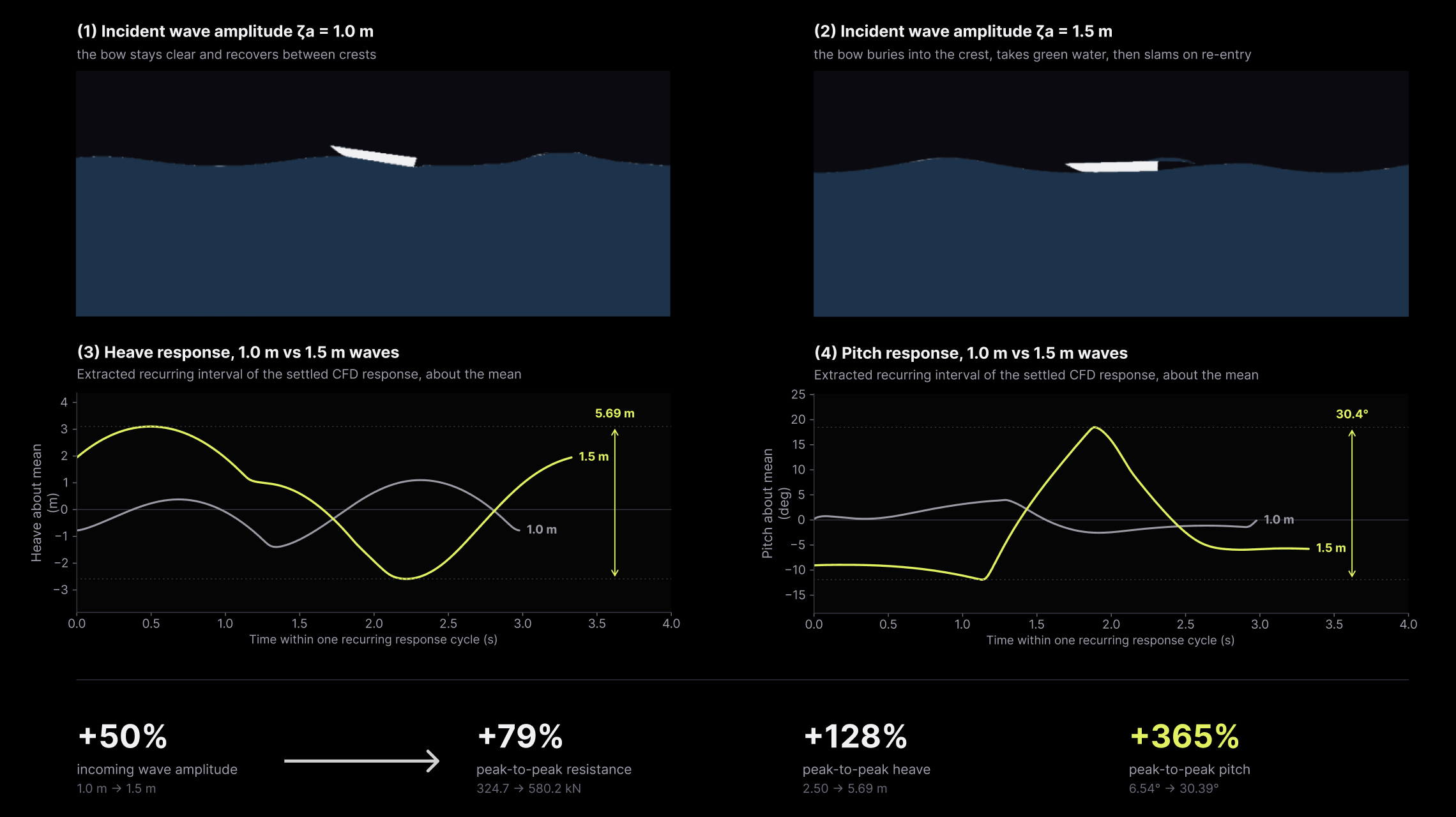
The clearest example of the nonlinear response appeared at the high-frequency 1.2 rad/s case. We evaluated the same vessel, speed, heading, and wave frequency at incident-wave amplitudes of 1.0 m and 1.5 m. The wave amplitude increased by 50%. The vessel response increased much more:
| Response | 1.0 m wave | 1.5 m wave | Increase |
|---|---|---|---|
| Peak-to-peak resistance | 324.7 kN | 580.2 kN | 79% |
| Peak-to-peak heave | 2.50 m | 5.69 m | 128% |
| Peak-to-peak pitch | 6.54° | 30.39° | 365% |
The physical interaction also became much more severe. In the higher-amplitude case, the bow buried into the oncoming crest, took green water over the foredeck, then swung clear above the water before re-entering the following wave and slamming.
This is exactly why vessel safety cannot always be inferred by smoothly extrapolating from nearby operating conditions. The vessel can cross into a different dynamic regime where relatively modest changes in the environment produce much larger changes in motion and loading.
For autonomous operation, identifying these boundaries is critical. If a candidate speed or heading is predicted to move the craft toward a severe response regime, the autonomy system can account for that before the maneuver is executed.
5 Making this physics available in real time with LIFT
A high-fidelity simulation campaign can give a detailed map of the vessel physics, but the computational cost makes conventional CFD unsuitable for onboard decision-making.
UniversalAGI uses a small set of high-fidelity simulations to fine-tune the Latent Interaction Field Transformer (LIFT), our foundation-model architecture for engineering physics. LIFT is designed to learn globally coupled physical systems while avoiding the computational cost of direct pairwise interaction across every spatial point. This allows large CFD-derived physical states to be compressed into a latent representation that can be evaluated efficiently on GPUs. We describe the architecture and training methodology in detail in our LIFT research article:
Real-time evaluation also depends on fast geometric preprocessing. Each volume prediction point is tokenized with information including its distance to the vessel surface, and these point-to-surface distances must be computed before the model can be evaluated at new query points. On CPU this took approximately 30 seconds for 10 million points. We optimized this step with NVIDIA Warp [10], running parallel closest-point queries against the hull geometry on GPU, which reduced latency to approximately 1.5 seconds. This 20× speedup keeps preprocessing cost negligible relative to model inference.
For maritime autonomy, the important consequence is the change in timescale. High-fidelity simulations establish the vessel physics over days of computation, while the trained physics AI model, together with GPU-accelerated tokenization, makes the learned response available at real-time inference speeds. This creates a direct path from detailed numerical hydrodynamics to onboard autonomous decision-making.
6 Nonlinear seakeeping physics in real time
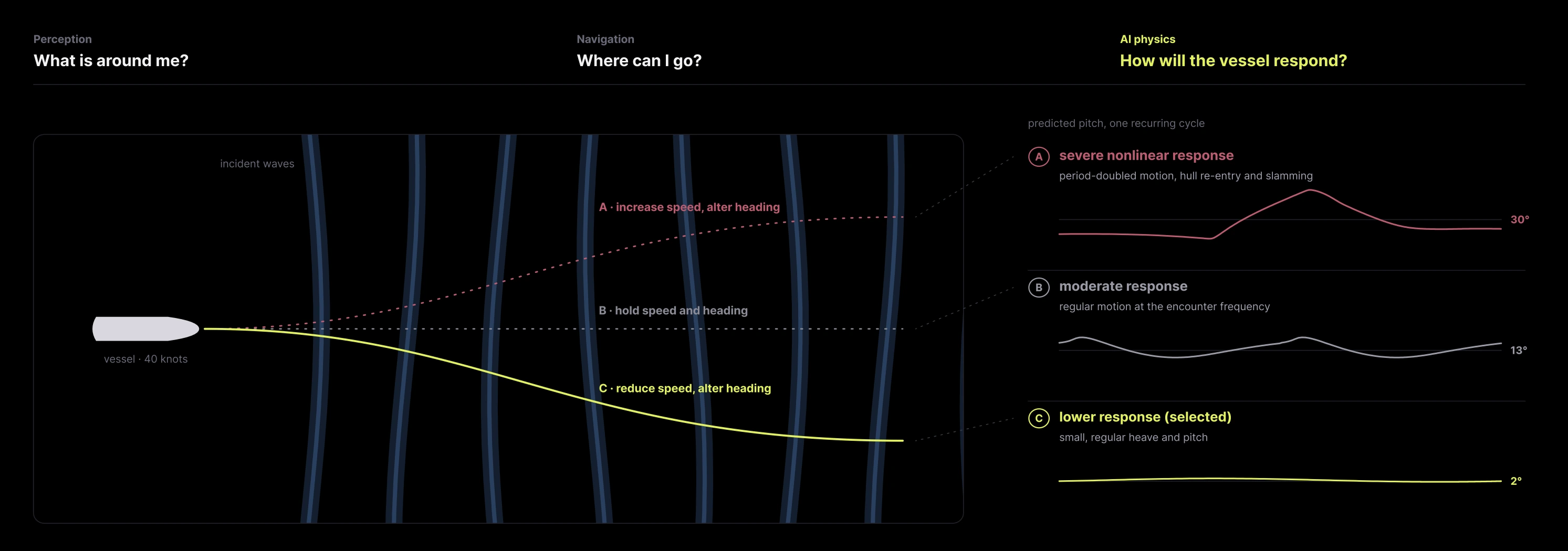
Maritime autonomy is advancing toward systems that can use more than perception and navigation when making operating decisions. Perception tells the craft what surrounds it. Navigation determines feasible routes. Real-time physics AI adds an understanding of how the vessel itself is expected to respond along those routes.
A candidate maneuver can therefore be evaluated against both the external environment and the vessel dynamics before it is executed. Speed and heading influence the physics together through the vessel’s velocity relative to the incoming waves, so a change in either alters the wave encounter and the response it produces. Small changes in operating condition can quickly move the craft toward or away from regions associated with severe heave, pitch, and hull re-entry. With LIFT running at GPU inference speeds, the autonomy stack can evaluate these effects while making the decision.
The importance of this capability becomes clearest near the limits of the operating envelope. Our analysis showed that a high-speed planing vessel can move rapidly from relatively regular motion into a much more severe nonlinear response. At the most demanding condition we evaluated, a 50% increase in wave amplitude produced a 365% increase in pitch response, period-doubled vessel motion, and substantially harder hull re-entry.
Making these dynamics available in real time through UniversalAGI’s LIFT-based physics AI models enables an autonomy system to account for the physical consequences of an operating decision while there is still time to act. If a candidate maneuver is expected to drive the craft toward severe heave, pitch, or hull re-entry, the system can use that prediction to select a safer speed, heading, or operating state before the vessel enters the dangerous regime.
Our collaboration with Saab, Inc.
This work was developed through UniversalAGI’s collaboration with Saab, Inc. on high-speed maritime autonomy. For more on the operational motivation behind the collaboration, its implications for sailors and mission-critical systems, and how real-time physics AI is supporting next-generation maritime autonomy, read our companion case study.
References
- Fridsma, G. (1969). A systematic study of the rough-water performance of planing boats. Regular waves. Davidson Laboratory Report 1275, Stevens Institute of Technology, Hoboken, NJ.
- Savitsky, D. (1964). Hydrodynamic design of planing hulls. Marine Technology, 1(1), 71–95.
- Zarnick, E. E. (1978). A nonlinear mathematical model of motions of a planing boat in regular waves. DTNSRDC Report 78/032, David W. Taylor Naval Ship Research and Development Center, Bethesda, MD.
- Mousaviraad, S. M., Carrica, P. M., and Stern, F. (2010). Development and validation of harmonic wave group single-run procedure for RAO with comparison to regular wave and transient wave group procedures using URANS. Ocean Engineering, 37, 653–666.
- Mousaviraad, S. M., Wang, Z., and Stern, F. (2015). URANS studies of hydrodynamic performance and slamming loads on high-speed planing hulls in calm water and waves for deep and shallow conditions. Applied Ocean Research, 51, 222–240.
- Judge, C., Mousaviraad, S. M., Stern, F., Lee, E., Fullerton, A., Geiser, J., Schleicher, C., Merrill, C., Weil, C., Morin, J., Jiang, M., and Ikeda, C. (2020). Experiments and CFD of a high-speed deep-V planing hull, Part II: Slamming in waves. Applied Ocean Research, 97, 102059.
- Lee, E. J., Mousaviraad, S. M., Weil, C. R., Jiang, M. J., Fullerton, A. M., and Stern, F. (2021). Assessment of experiments and CFD for the semi-planing R/V Athena model in waves. Ocean Engineering, 238, 109725.
- Perić, R. and Abdel-Maksoud, M. (2017). Reliable damping of free surface waves in numerical simulations. Ship Technology Research, 65(1), 1–16.
- Choi, J. and Yoon, S. B. (2009). Numerical simulations using momentum source wave-maker applied to RANS equation model. Coastal Engineering, 56(10), 1043–1060.
- NVIDIA. (n.d.). NVIDIA Warp. NVIDIA Developer. https://developer.nvidia.com/warp-python