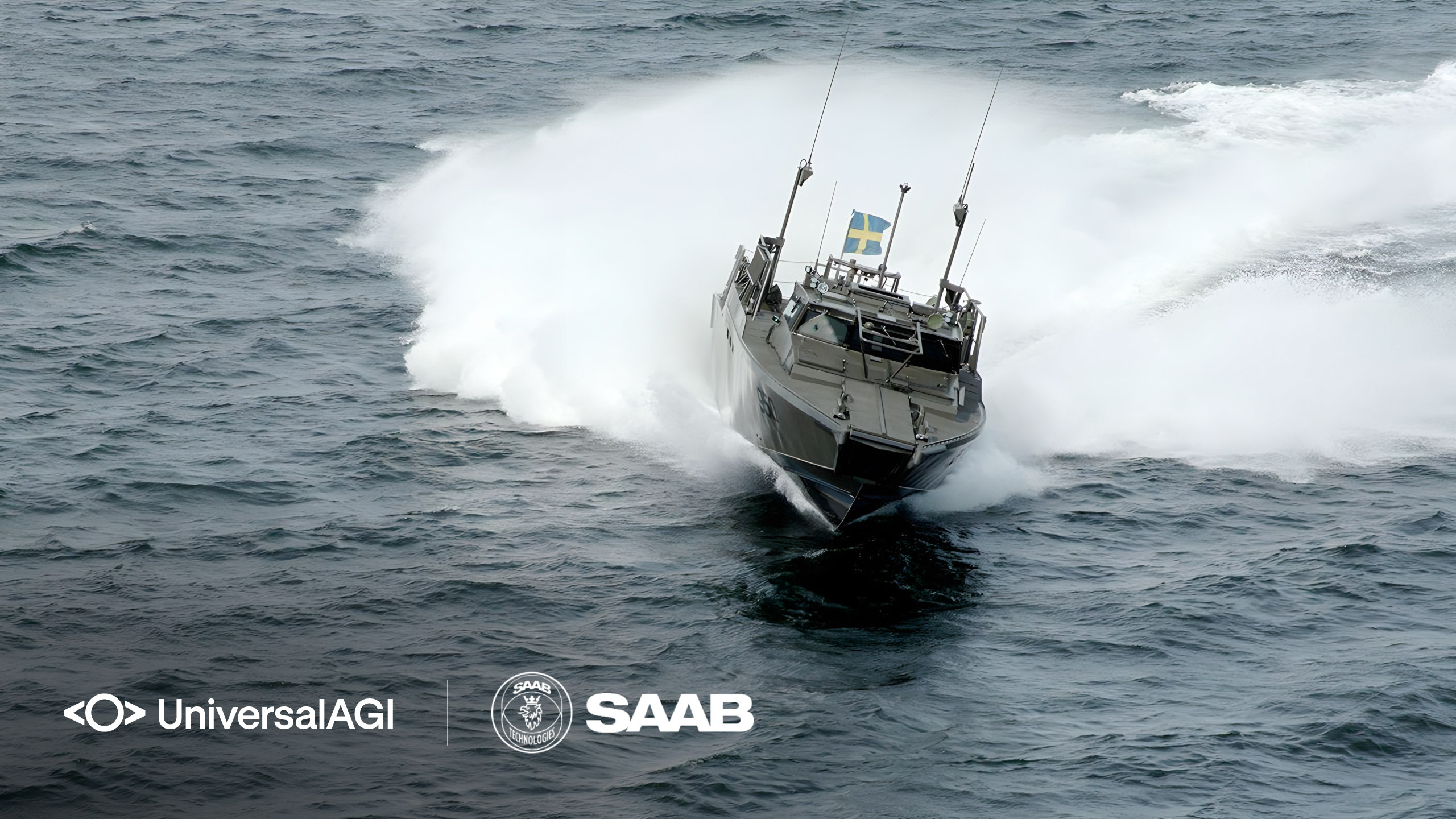
The collaboration between UniversalAGI and Saab, Inc. enables detection of potentially dangerous vessel behavior, reducing the risk of serious injury and damage to sensitive equipment while improving the efficiency and effectiveness of critical missions in challenging and adversarial environments.
At high speeds in rough seas, a naval vessel can transition within seconds from controlled motion to violent heave, pitch, and hull re-entry. These forces can cause serious injuries to personnel, as characterized by ISO vibration dose value (VDV) metrics, and damage mission-critical equipment and sensors supporting autonomy, situational awareness, electronic warfare, and other capabilities. National security missions cannot make assumptions about compliant weather and sea states. Adversarial weather-influenced operating domains must be considered when designing service-based autonomy.
Wave slamming takes a toll on the warfighter
The toll on sailors is well documented. In a survey of retired U.S. Naval Special Warfare Combatant-Craft Crewmen, respondents reported 2,460 impact-related injuries across 2,318 person-years of service aboard high-speed boats, more than one injury for every year served [1]. Of those respondents, 70% reported impact injuries that ultimately impaired their capacity to perform their job aboard, 33% reported temporary loss of consciousness as a result of wave slamming, and 90% reported one or more injuries, of whom 39% needed surgery while still serving.
Saab, Inc. and UniversalAGI are solving an important problem at the speed of AI
Saab, Inc. [2], the U.S. arm of global aerospace and defense company Saab, is advancing maritime autonomy by enabling autonomous systems to anticipate, quantify, and mitigate risks posed by the physical environment. Intelligent, resilient autonomy already uses perception and situational awareness to interpret its surroundings and adapt its behavior. Persistent and unpredictable wave motion, however, presents a distinct challenge, requiring real-time adjustments informed by how the system is interacting with a continuously changing environment.
To address this challenge, Saab, Inc. developed a motion-compensation controller that uses wave-excitation estimates to cancel vessel motion at critical onboard locations. Critically, Saab, Inc. studied energy interactions with the human musculoskeletal system, informing the design of active and passive mechanisms to reduce human vibration dose values (VDVs) and associated injury risks. This work required a comprehensive analysis of fluid-structure interactions across a broad range of sea states, vessel speeds, headings, and operating conditions.
The technical challenge is highly dynamic: a moving hull interacts with an air-water interface that is itself constantly changing. As the vessel pitches upward, its wetted surface and pressure distribution shift. Those loads drive the vessel’s subsequent heave and pitch, changing how the hull encounters the next wave. Spray forms and separates, the transom ventilates, portions of the hull may leave the water entirely, and the next wave can produce an abrupt, high-impact re-entry. At high speeds, this sequence may repeat every few seconds.
Traditionally, capturing this behavior across the vessel’s operating envelope requires a separate high-fidelity, transient seakeeping simulation for nearly every combination of wave conditions, speed, heading, and vessel state. Computational fluid dynamics (CFD) is commonly used for this purpose, but these simulations are slow and computationally intensive. A single case can take days to complete, while a sufficiently broad simulation campaign can consume hundreds of thousands of central processing unit (CPU) core-hours and cost tens of thousands of dollars before the vessel’s response envelope is adequately characterized.
From high-fidelity CFD to real-time physics AI
Bringing high-fidelity seakeeping physics into real-time decision-making is exactly where the UniversalAGI solution provided the greatest lift. UniversalAGI built and validated a high-fidelity seakeeping simulation pipeline, characterized the vessel response across a range of wave conditions, and used the results to develop real-time physics AI capability using UniversalAGI’s Latent Interaction Field Transformer (LIFT) model architecture.
The resulting analysis revealed a sharp nonlinear transition in the vessel dynamics. At the most demanding condition evaluated, increasing incoming wave amplitude by 50% produced 79% greater peak-to-peak resistance, 128% greater heave response, and 365% greater pitch response. The vessel also developed a period-doubled response with substantially harder hull re-entry.
These transitions matter to autonomous operations. A maneuver that appears safe based on perception and navigation can expose the vessel to a dramatically different physical response as the sea state, speed, or heading changes.
By making vessel-response physics available at graphics processing unit (GPU) inference speeds, UniversalAGI gives Saab, Inc. a path to incorporate predicted heave, pitch, loading, and dynamic response directly into real-time navigation and control, with extensions to mission-critical operations requiring dynamic stability control.
Highlights
- UniversalAGI is helping Saab, Inc. integrate predictive vessel physics into the autonomy decision loop, enabling potential maneuvers to be evaluated against expected vessel responses across a range of sea states.
- The underlying fluid-structure interaction physics was validated through a rigorous hierarchy that included published planing-hull experiments, Savitsky theory, nonlinear Zarnick strip theory, dedicated wave-propagation studies, and high-fidelity transient seakeeping computational fluid dynamics (CFD) simulations.
- Under the most demanding condition evaluated, a 50% increase in wave amplitude resulted in 79% greater resistance, a 128% increase in heave response, and a 365% increase in pitch response.
- The vessel transitioned into a strongly nonlinear, period-doubled response, demonstrating why behavior in demanding operating conditions cannot always be reliably extrapolated from nearby conditions.
- UniversalAGI’s LIFT physics AI model makes the learned vessel dynamics available at GPU inference speeds, supporting real-time autonomous decision-making.
The science behind UniversalAGI’s real-time physics AI
The underlying seakeeping problem is highly nonlinear and computationally demanding. Our technical article describes how we established and validated high-fidelity physics, identified the transition to period-doubled vessel response, quantified the nonlinear effect of increasing wave amplitude, and used UniversalAGI’s LIFT architecture to make the learned dynamics available at GPU inference speeds.
References
- Traumatic Brain Injury Center of Excellence, Clinical Translation Office. (2025). Information Paper on Military High-Speed Boat Injuries. Content current as of February 2025. https://health.mil/Reference-Center/Publications/2025/03/13/Information-Paper-on-Military-High-Speed-Boat-Injuries
- Saab, Inc. https://www.saab.com/markets/united-states